
If you have ever checked your rankings and been told that your site „lacks backlinks”, the natural question is what they actually are and why there is so much fuss about them. The answer is simpler than the jargon suggests.
A backlink is a link from another website to yours. Google treats it as a recommendation, and the weight of that recommendation depends on who gave it: one link from a topical site with 500+ monthly visitors is worth more than a hundred links from directories and comments.
In this article I explain what a backlink is made of, how Google evaluates it, which types exist, how to check your own link profile in Search Console in five minutes, and which rule to use when deciding whether a specific link is worth paying for.
What is a backlink in plain terms?
A backlink is an ordinary HTML link, except that it sits on someone else’s website rather than yours. When a business portal writes „as SEO specialist Augustinas Sokolenko explains” and those words are clickable, the portal has created a backlink to my site.
Technically it looks like this: <a href="https://your-site.com/page">link text</a>. Within that one line, Google evaluates four parts separately, and they decide whether the link means anything at all:
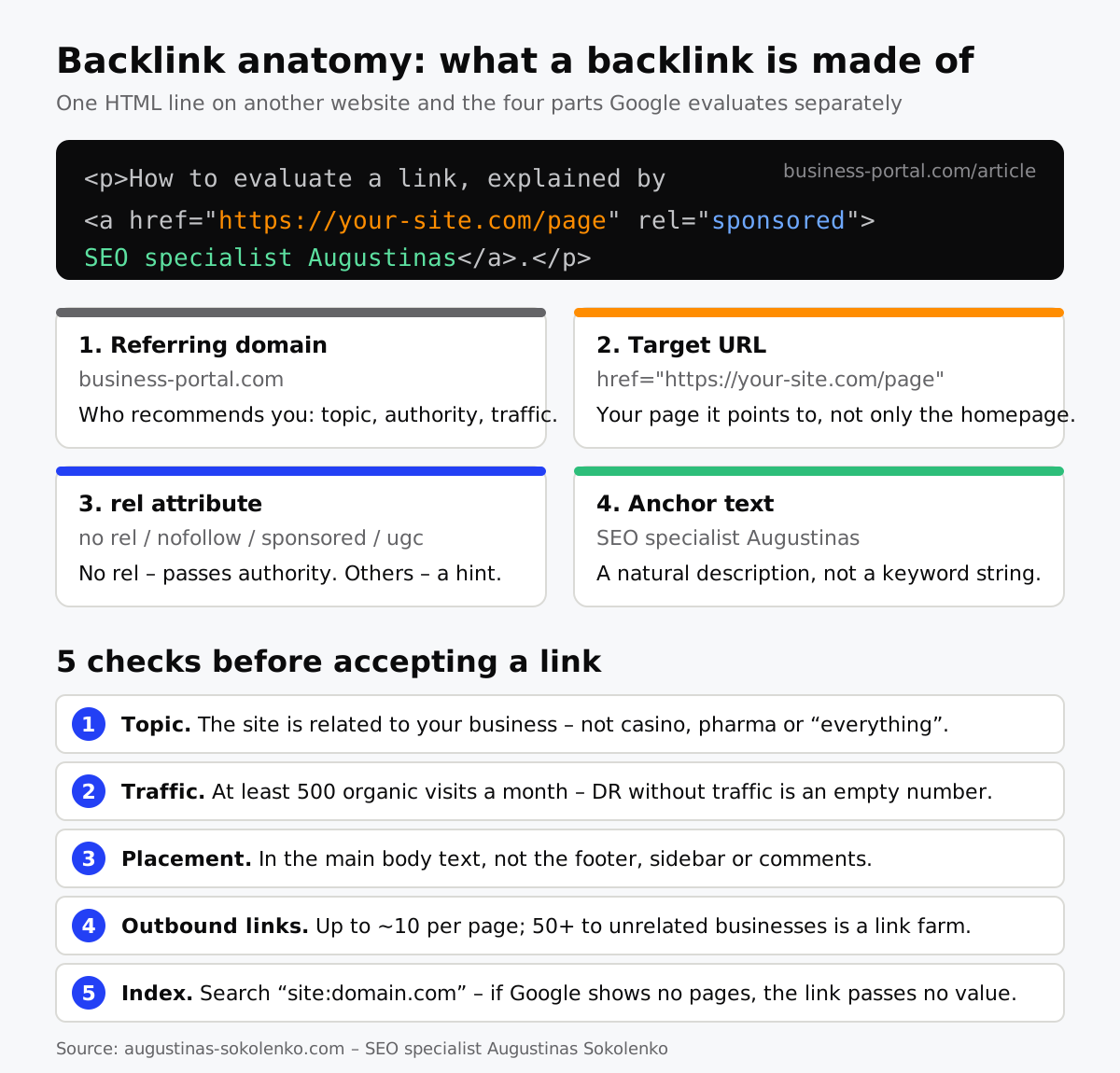
- Referring domain – the website where the link is placed. This answers the question „who is recommending you”.
- Target URL – the specific page on your site the link points to. What an address itself means, I covered in what is a URL.
- rel attribute – a tag that tells Google how to treat the link (more on it below).
- Anchor text – the visible words people click on. They tell Google what the linked page is about.
To avoid confusion, it helps to know what a backlink is not. A link from one page of your site to another is an internal link, not a backlink. Your company name mentioned in an article without a clickable link is a mention: it helps the brand but passes no authority. A link from your social media profile is technically a backlink, but it almost always carries a nofollow tag, so it has no direct effect on rankings.
Why does Google value backlinks?
Google values links because they are an independent signal: you can fix your content and your technical setup yourself, but a link has to be given by someone else. That is why backlinks are usually what separates page two from page one once content and technical SEO are already in order.
The principle is as old as Google itself and is called PageRank: every link is a vote for a page, and the weight of the vote depends on how many votes the voter has. Over more than twenty years the algorithm has learned to tell natural links from artificial ones and to weigh the topic of the source, but the foundation is unchanged.
A backlink does three jobs at once:
- It lifts rankings. Links from trusted, topically related sites raise the authority of the page and of the whole domain.
- It helps Google find pages. The crawler travels along links, so a new page is often discovered through a link from another site before it is picked up from the sitemap.
- It brings visitors. A link in an article your potential customers read brings enquiries regardless of rankings. This is often forgotten, even though the traffic from the right portal is sometimes worth more than the SEO effect.
What types of backlinks are there?
Backlinks are classified by three criteria: the rel attribute, the placement on the page, and how the link came to exist. The table shows what each type means for your site.
| Type | What it is | Effect on rankings |
|---|---|---|
Dofollow (no rel attribute) |
A standard link | Passes authority – this is the kind you want |
Nofollow (rel="nofollow") |
A tag saying „I don’t vouch for this link” | Passes almost no authority, but brings traffic |
Sponsored (rel="sponsored") |
A tag for paid links and ads | Like nofollow; Google’s documentation names it as the preferred tag for paid links |
UGC (rel="ugc") |
User-generated content – comments, forums | Like nofollow |
| Contextual | In the main body text, in a related sentence | The strongest placement of all |
| Footer / sidebar | Repeated on every page of the site | Weak; a hundred such links from one site count as one domain |
| Directory / profile | Business directories, registers | Weak, but a natural part of a profile; useful for local SEO |
| Editorial | The author cited you because the content was useful | The strongest and the hardest to get |
| Placed (guest post) | A publication on a portal with a link | Medium to strong, depending on the portal |
One important detail about rel attributes: Google’s documentation says links marked this way are generally not followed, and a paid link tagged sponsored or nofollow does not violate the rules. In other words, a legal way to buy a link exists; it just does not pass authority.
What determines the value of a single link?
The value of a link is decided not by the domain rating but by five things you can check in a minute: the topic of the source, real organic traffic, placement on the page, the number of outbound links, and whether the site is in Google’s index at all.
Before placing a link on any of my projects I check exactly these five points (they are summarised in the infographic above):
- Topic. The site and the specific page relate to your business. A link from an accounting portal to accounting services is worth more than links from ten portals „about everything”.
- Traffic. At least 500 organic visitors a month according to Ahrefs or Semrush. DR (domain rating, a tool’s estimate of domain strength) without traffic is an empty number, because it is easy to inflate artificially.
- Placement. The link sits in the main text, not in the footer, sidebar or comments.
- Outbound links. If one article contains 50 links to unrelated businesses, it is a link farm, not a portal.
- Index. Type
site:domain.cominto Google. If there are no results, the site is not indexed and the link passes no value.
To these I add a simple decision rule: if a link fails more than one of the five criteria, I do not pay for it, whatever the DR. A cheap link that passes nothing is the most expensive one, because you paid for it in vain.
Another thing worth counting is referring domains, not links. Ten links from ten different real websites are worth more than a thousand links from three domains. That is the first metric I look at when I run an SEO audit for a new client.
How many backlinks do you need and what do they cost?
There is no universal number, but there is a method: count how many referring domains the three competitors ranking first for your keyword have, and aim for their average. If they have 18, 25 and 32 domains and you have 6, you are roughly 19 links from different sites short. How to plan the work around that is covered in my article on what off-page SEO is.
Prices in the Lithuanian market in 2026 depend on the strength of the portal. In my link building services pricing, one link from a topical portal with DR 20+ and 500+ organic visitors costs €50, the DR 35+ tier is €90, and DR 40+ with 3,000+ visitors is €150. At those prices you are paying not for the number but for a real site with an audience: a €150 link from a portal your customers read usually pays back faster than three at €50.
Pace matters too. A new site that picks up 100 links in a month looks unnatural; 4–8 links a month from different topical sources is a rhythm that raises no questions and lets you measure the effect.
How to check your backlinks for free
The fastest way is the Links report in Google Search Console: it shows which sites link to you, which of your pages they link to and with what text, and it needs no paid tool.
You will find the report in the left-hand Search Console menu under „Links”. According to the Search Console help, it has three tables, and each is worth reviewing with a specific question in mind:
- Top linking sites: is the list dominated by real topical sites, or by unknown domains you have never seen? The second case usually means automatically generated links that Google ignores.
- Top linked pages: if 90 % of links point to the homepage, your service and article pages get no authority. Those are the pages that need to rank.
- Top linking text: in a natural profile the company name and URL dominate. If 80 % of anchors are the same commercial keyword, the profile looks artificial.
Check the report once a month and compare the number of referring domains with the previous month. Growth of 3–5 domains a month with steady work is normal; a sudden jump of several hundred unknown domains is a reason to find out where they came from.
If you also want to see competitors’ links, you will need Ahrefs or Semrush, but for your own profile Search Console is enough.
Which backlinks are harmful and what to do about them?
What harms you is not „bad” links as such but link schemes: any links created to manipulate rankings. Google’s spam policies list examples such as buying and selling links without a sponsored tag, excessive link exchanges, automated link-building programs, low-quality directories, links in footers and templates, and forum comments with optimised links.
In practice the consequences come in two forms. Most often Google simply ignores such links and only your budget suffers. Less often, but more painfully, the site receives a manual action, visible in Search Console under „Manual actions”, and rankings drop within days. Recovering from that takes months.
What should you do about suspicious links you did not build? Usually nothing. Google recommends the disavow tool only when you have a manual action or have previously bought links at scale yourself. Every site has a few dozen spam links from unknown directories, and Google handles them on its own. If you are unsure whether your profile needs cleaning, that is one of the questions we can go through in a free 15-minute call.
How do you get backlinks?
Every method that works rests on one principle: the site linking to you must have a reason to do so. The fastest links are the ones you have already earned – from partners, suppliers, directories and articles that mention you without a link. Guest posts on topical portals give you a pace you can plan, while expert comments for the media and content that others cite take the most work.
In every case, choose natural link text: the company name, the URL or a descriptive phrase. I cover all nine methods with cost, timing and a 90-day plan in a separate article on how to get backlinks in Lithuania.
Frequently asked questions
Are „backlink” and „inbound link” the same thing?
Yes, they are the same thing under different names. SEO practice also uses „external link” and „incoming link”. All of them mean a link from another website to yours.
Are nofollow links useful?
For rankings directly, almost not, but they are still useful. A nofollow link from a portal with a large audience brings visitors, and a natural link profile always contains a share of nofollow links: a profile made entirely of dofollow links looks artificial in itself.
Can you buy backlinks?
You can, if the link is tagged rel="sponsored" or rel="nofollow": then it does not break the rules, but it does not pass authority either. A paid link without a tag is a link scheme under Google’s spam policies. In practice the line runs through quality: a commissioned expert article on a real portal that people read, and a link from a site that exists only to sell links, are entirely different things.
How long does it take for a backlink to work?
Usually 4–12 weeks from publication, because Google has to process the page with the link and recalculate the signals. A stable change in rankings from link work is something I typically see after 3–6 months, once a dozen or so links from different domains have accumulated.
Are links from Facebook or LinkedIn backlinks?
Technically yes, but social media links carry a nofollow tag, so they pass no authority. Their benefit is different: traffic, brand mentions and faster discovery of new content.
How many backlinks should a new website have?
For the first three months, 10–15 referring domains from natural sources are enough: business registers, partners, associations and 2–3 guest articles on topical portals. What matters more than the number is that links do not all point to the homepage and that they arrive steadily rather than all in one week.