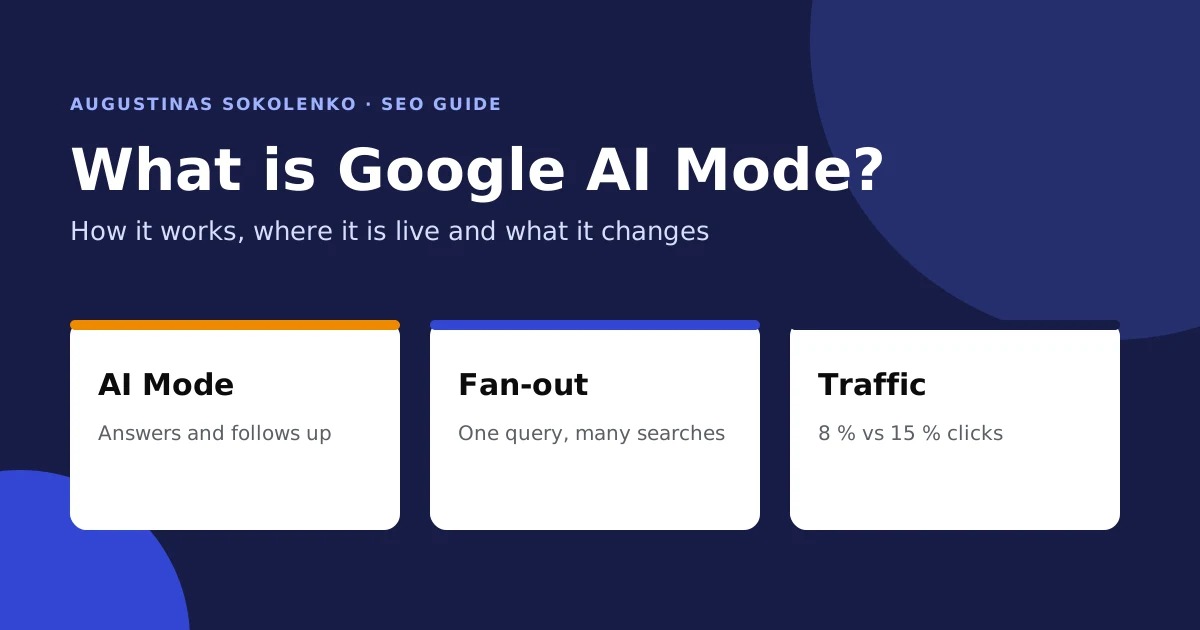
You type a question into Google and, above the usual results, a tab called „AI Mode” appears with a long answer and a handful of links. Since October 2025 this feature has been live in Lithuania and in Lithuanian, so the question is no longer „when will it arrive” but „what do we do about it”.
Google AI Mode is a separate mode of Google Search in which artificial intelligence answers your question: it breaks the query into several additional searches, combines what it finds into a single answer with links to sources, and lets you continue the conversation with follow-up questions. Since 7 October 2025 it has been available in more than 200 countries, including Lithuania, and supports Lithuanian.
Below: how AI Mode differs from AI Overviews and regular search, how to open it, how much it changes traffic to websites, and what a business should do to stay visible.
How is Google AI Mode different from AI Overviews and regular search?
An AI Overview is a short summary above the regular results, while AI Mode is a separate tab where AI writes the whole answer and you can ask the next question. Regular search stays where it was: ten links you choose from yourself.
| Regular search | AI Overview | AI Mode | |
|---|---|---|---|
| Where it appears | Main results page | Block above the results | Separate „AI Mode” tab |
| When it appears | Always | Only when Google decides a summary adds value | When the user chooses it |
| How the answer is built | Ranked list of links | Short AI summary with a few links | Detailed AI answer from several searches, with links |
| Conversation | No | No | Yes – follow-up questions |
| Best for | Finding a specific page | A quick fact | Complex, multi-part questions and comparisons |
The decision rule is simple: if you are looking for a specific page or company, regular search is faster. If your question sounds like „compare X and Y for my situation”, AI Mode saves you 3–5 separate searches.
How AI Mode works: query fan-out
AI Mode works on a principle Google calls query fan-out: the system splits one question into subtopics, runs a separate search for each, and merges the results into one answer. That means dozens of pages you would never have seen in regular search can sit behind a single answer.
Example: the question „which heat pump should I choose for a 120 m² house in Kaunas and what will it cost per year” is split into pump types, power calculation, electricity prices and installer offers. Each part is searched separately. This is why Google’s documentation for site owners says its AI features can show a wider and more diverse set of links than classic search, with the answer generated by a Gemini model customised for Search.
One important exception: the quality of the answer depends on what is already indexed. If your website is not in regular search, it will not be in AI Mode either.
Does AI Mode work in Lithuania, and how do you open it?
Yes – on 7 October 2025 Google expanded AI Mode to more than 35 new languages and 40 countries, and its official help page lists Lithuania among supported countries and Lithuanian among supported languages. There is nothing to enable; you simply pick the mode:
- In a browser, open google.com/ai, or type a question on google.com and click the „AI Mode” tab.
- In the Google app on your phone, tap the AI Mode button on the home screen.
- Ask by typing, by voice or by uploading a photo – the mode accepts all three.
A few limits worth knowing. Personalisation based on search history works only when signed in and aged 18 or over. The more advanced paid model (the help page calls it „Gemini 4 Argon”) is not yet available in Lithuania, so Lithuanian users see the base version. The mode works in an incognito window, but without history.
How much do AI Mode and AI Overviews change traffic to websites?
The most reliable independent measurement shows that an AI summary on the results page cuts clicks to websites almost in half. In a Pew Research Center study published in July 2025, which analysed 68,879 real Google searches, users clicked a traditional result 8 % of the time when an AI summary was shown and 15 % of the time when it was not. Only 1 % clicked a link inside the summary itself. A summary appeared on 18 % of searches.
What this means in practice:
- Informational questions („what is”, „how does it work”, „what does it cost on average”) lose the most – the answer is obtained without a visit.
- Commercial and local questions („heat pump installation in Kaunas”, „dentist in Vilnius”) suffer less, because the service still has to be ordered from a specific provider.
- Click quality changes: Google says visitors arriving from AI features spend more time on the site, because they already have the answer and come to act.
You cannot yet separate AI Mode traffic in Search Console: Google’s documentation says impressions and clicks from AI Overviews and AI Mode are included in the overall „Web” search type. A practical way to track the change is to compare the click-through rate (CTR) of your informational pages before and after October 2025. I run that comparison as part of an SEO audit.
What should a business do to be cited in AI Mode answers?
No special „AI SEO” is needed – Google’s documentation says plainly that there are no additional requirements or special optimisations for appearing in AI Overviews or AI Mode. But because of query fan-out, the pages that win are the ones that clearly answer a specific subtopic. A practical checklist:
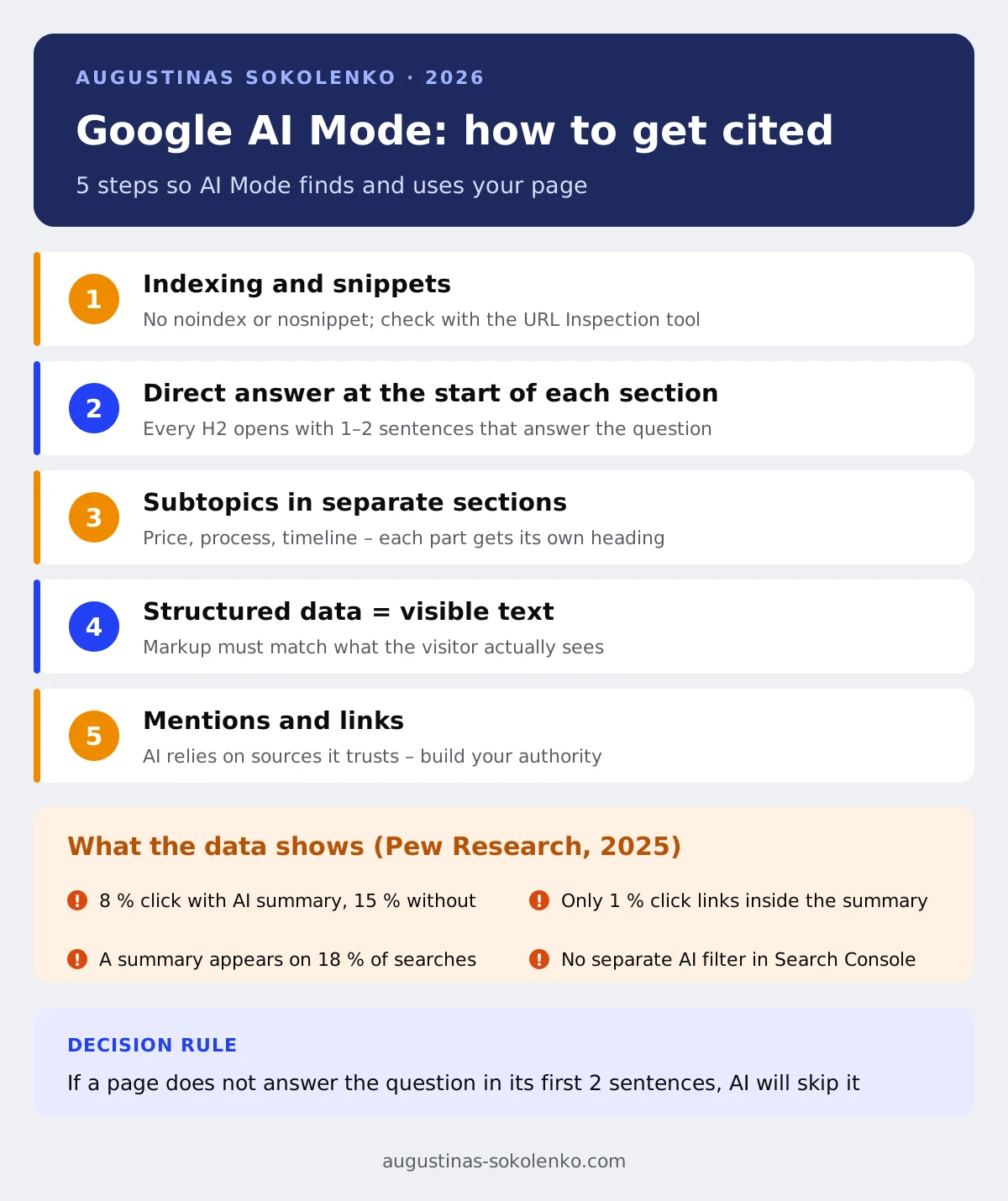
- Indexing and snippets. The page must be indexed, without
noindexornosnippet. Check it with the URL Inspection tool in Search Console – this is the first place visibility disappears. - A direct answer at the start of each section. Every H2 should open with 1–2 sentences that answer the question without a preamble. Those are exactly the fragments the system pulls into an answer.
- Subtopics in separate sections. If a question is split into price, process and timeline, each part needs its own heading with concrete numbers, not generalities.
- Structured data that matches the visible text. Google stresses that markup must match what the visitor sees – a mismatch hurts rather than helps.
- Brand mentions and links. AI answers rely on sources they trust, so mentions on authoritative portals matter even more. More on that in the article on off-page SEO.
If you want to check which of your pages answer questions and which merely repeat them, that can be settled in a single SEO consultation.
How do you stop your content appearing in AI Mode?
You cannot opt out of AI Mode completely while staying in regular search, because both use the same Googlebot index. You can only restrict snippets: nosnippet blocks any text fragment, data-nosnippet blocks a marked part, and max-snippet limits the length. The separate Google-Extended agent controls only training and grounding for the Gemini app and API, not Search. Before blocking, weigh the cost: without snippets the page also loses its description in the regular result.
Frequently asked questions
Will AI Mode replace regular Google Search?
No, at least not in the near term – it is a separate tab the user chooses. Google is moving some of its features into AI Overviews, but the classic results list remains the default.
Does AI Mode show ads?
In the US Google is already testing ads inside AI Mode answers; in Lithuania, as of autumn 2026, they are not yet visible. Since advertising is Google’s core revenue, ads are likely to appear here too, but the format is still changing.
How is AI Mode different from ChatGPT or Gemini?
AI Mode builds every answer from live search results, so it contains more fresh sources and links. The ChatGPT or Gemini chat apps rely more on the trained model and switch on search only when needed.
Can I see that my website was shown in AI Mode?
Not directly. In Search Console these impressions and clicks are counted under the overall „Web” type with no separate filter, so you only see the combined change. Indirectly, you can watch for CTR drops on informational pages whose position has not changed.
Do keywords still matter when queries become long and conversational?
Yes, but their form changes. Long, question-shaped queries and their subtopics become more important than two-word phrases, so keyword research should collect not just search volumes but the questions the system splits into fan-out searches.
Does AI Mode work as well in Lithuanian as in English?
Lithuanian is supported, but some features (such as the advanced model or interactive visuals) currently work only in English and not in every country. The depth of answers on Lithuanian topics also depends on how much quality Lithuanian content on the subject is indexed at all.