You can have a fast website, good copy and tidy headings and still be stuck on Google’s second page. The most common reason is that competitors have more authority – and authority is built not by your website, but by what others say about it.
Off-page SEO is everything done outside your website that increases its authority in search engines: backlinks from relevant websites, brand mentions, reviews and citations. Links are still the strongest signal – Google confirms that PageRank, its link analysis system, is still part of its core ranking systems.
Below: how off-page SEO differs from on-page SEO, how to tell a valuable link from a harmful one, what it costs and how long it takes to see results.
How is off-page SEO different from on-page SEO?
On-page SEO covers what you control yourself – content, headings, technical health. Off-page SEO grows the trust other sources give your website. Each works poorly without the other.
| On-page SEO | Technical SEO | Off-page SEO | |
|---|---|---|---|
| Where it happens | On your pages | In the website’s infrastructure | On other websites and platforms |
| Examples | Keywords, headings, meta data, internal links | Speed, indexing, robots.txt, structure | Backlinks, mentions, reviews, PR |
| Who controls it | You | You | Partly others |
| What Google asks | What is this page about? | Can I reach and understand it? | Can it be trusted? |
The decision rule is simple: if a page is not indexed or does not match search intent, links will not save it. That is why I start off-page work with an SEO audit and keyword research – they show which pages lack authority the most.
What does off-page SEO include?
Off-page SEO is made up of four types of signals. Links carry the most weight, while the other three help the link profile look natural.
Backlinks
A backlink is a link from another website to yours. Google reads it as a recommendation: the more trustworthy and topically close the source, the more value it passes. What matters is not only the number of links, but also how many different domains link to you (referring domains). Ten links from one portal are usually worth less than one link each from ten different websites.
Brand mentions and citations
These are mentions without a link, company listings in directories, your Google Business Profile and reviews. For local businesses it is especially important that the name, address and phone number (NAP) match everywhere.
Guest posts and digital PR
Articles on portals and niche blogs, expert comments for the media, studies that others cite. In Lithuania this is the main way to earn contextual links – links woven into the text rather than hidden in a footer.
Social signals
Links on social networks usually carry the nofollow attribute, so they do not pass authority directly. Their value is indirect: more people see your content, and some of them may later link to it from their own websites.
How Google evaluates links: quality beats quantity
One link from a topically close website with real traffic often does more than dozens of directory links. What counts is the source’s trustworthiness, its topic, where the link sits in the text and whether the whole profile looks natural.
5 checks before placing a link
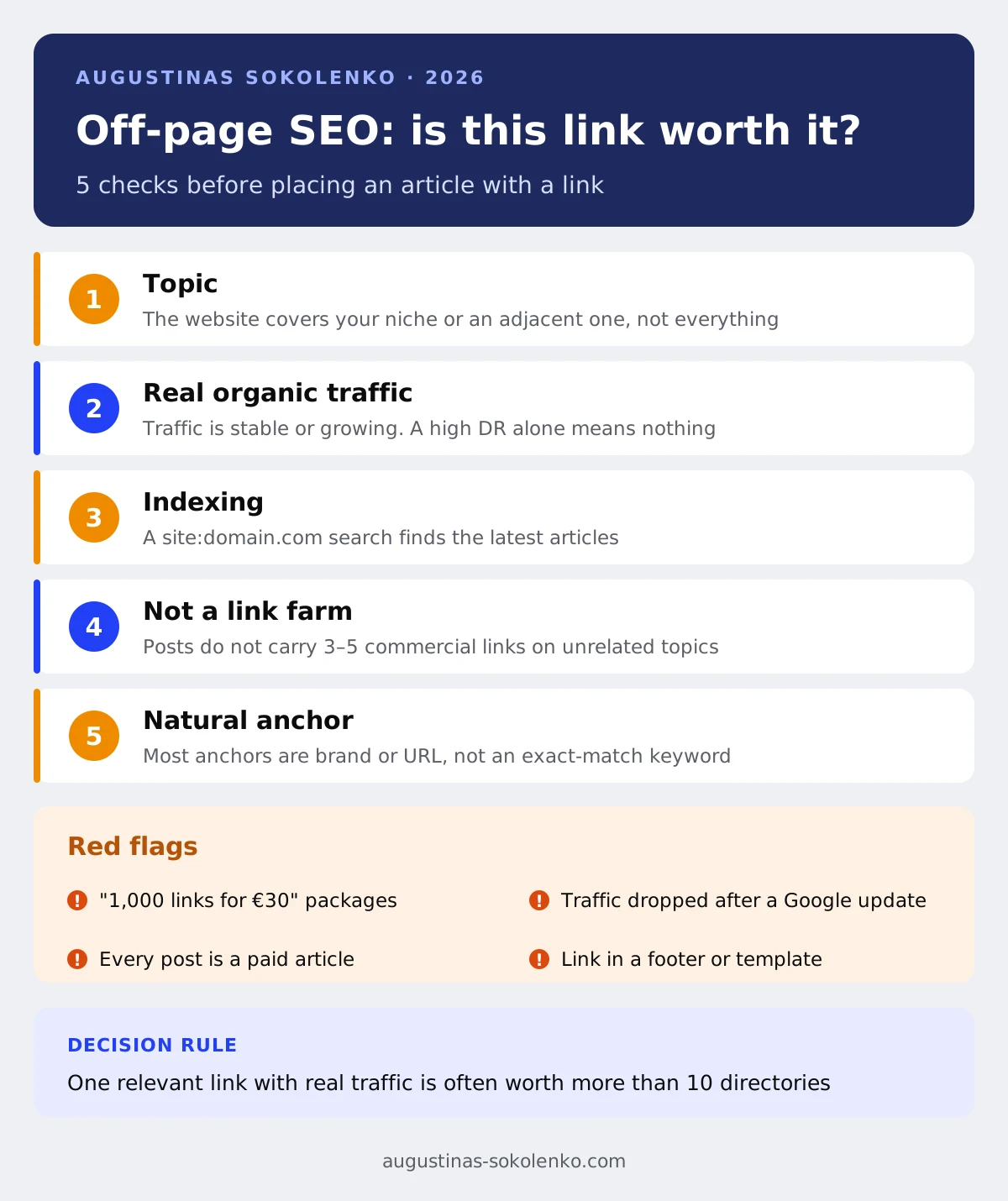
- Topic. The website writes about your niche or an adjacent one. For a construction company, a link from an interior design blog is worth more than one from a general news directory.
- Real organic traffic. Look not only at DR (Domain Rating, Ahrefs’ authority metric) but also at the traffic curve. DR 40 with no visitors often means an artificially inflated website.
- Indexing. Search Google for
site:domain.com. If Google cannot find the latest articles, the link will not work. - Not a link farm. If every post carries 3–5 commercial links on unrelated topics, the website lives off selling links.
- Natural anchor. Anchor text is the clickable text of a link. Most of your profile should be brand, URL and generic anchors, with exact-match keyword anchors in the minority.
Because of the second point, my pricing defines link tiers not only by DR, but also by minimum Ahrefs traffic and CF/TF metrics.
Dofollow, nofollow and sponsored links
A regular link without attributes passes authority – it is called dofollow. The attributes rel="sponsored" (paid placements), rel="ugc" (comments, forums) and rel="nofollow" tell Google what kind of link it is, and such links are generally not followed. A natural profile contains both types.
Which links can hurt you?
Google treats links created mainly to manipulate rankings as link spam. Its spam policies list examples such as:
- buying or selling links for ranking purposes when the link is not marked
sponsoredornofollow; - excessive link exchanges („link to me and I’ll link to you”);
- automated programs that create links;
- low-quality directory and bookmark sites;
- widely distributed links in the footers or templates of other websites.
In practice, cheap „1,000 links for €30” packages are a risk, not an investment. Review your link profile regularly in the „Links” report of Google Search Console. The disavow tool is worth using only after a manual action or when you see a mass spam attack. Otherwise Google usually just ignores such links.
How much does off-page SEO cost and how many links do you need?
Off-page SEO is usually paid per link or as a monthly package, and the price depends on the source’s authority and traffic. Prices for my link building services:
| Tier | Price per link | Minimum traffic (Ahrefs) | Quality metrics |
|---|---|---|---|
| DR 20+ | €50 | 500+ | CF and TF 15+ |
| DR 35+ | €90 | 500–1,000+ | CF and TF 22+ |
| DR 40+ | €150 | 3,000+ | CF and TF 30+ |
In every case the link is placed on a relevant niche website, with 14-day delivery.
How many links your website needs is best shown by competitors, not by a general rule:
- Find the 3 websites ranking in the top 3 for your main keyword.
- Use Ahrefs or Semrush to check how many different domains link to their specific page, not the whole website.
- Set a goal to get close to their average within 6–12 months – steadily, not in a single month.
Example: competitor pages have 18, 25 and 32 referring domains, an average of 25. Your page has 6, so you are 19 short. That is roughly 2 links a month for almost a year. If you are not sure how many your website is missing, I can assess it in an SEO consultation.
How long until you see results, and how to measure them?
The first ranking changes after placing links usually appear within 4–12 weeks, with a stable effect in 3–6 months. Speed depends on how quickly Google indexes the article with your link and on competition in the niche.
Measure three things:
- Rankings and impressions of target pages in Google Search Console, not the site-wide average.
- The number of referring domains – is it growing steadily?
- Whether articles with your links are indexed – check each one after 2–4 weeks.
These timelines do not apply everywhere. In very competitive niches (loans, legal services, real estate) 6 months may not be enough, and on a new domain the first months often go into building trust.
Off-page SEO and AI search
AI overviews and conversational search systems build answers from sources they trust, so brand mentions on authoritative portals become even more valuable. Aim not only for a link but for context: an article should name your company as a solution in a specific field („X – SEO specialist in Kaunas”), not hide it behind the word „here”.
Frequently asked questions
Can a website grow without off-page SEO?
Yes, if competition in the niche is low or you target long, specific queries. For competitive keywords, on-page SEO alone is usually not enough – rankings stall on page 2–3 even when the content is good.
Does Google penalise buying links?
Google’s policy prohibits buying links for ranking purposes unless they are marked sponsored or nofollow. In theory this also applies to paid guest posts, but in practice penalties mostly hit mass, obvious schemes and link farms.
How many links per month is safe?
There is no safe number – what matters is a pace that matches the website’s size and history. For a new website, 2–4 quality links a month looks more natural than 20 in a week followed by silence.
Is DR a Google metric?
No. DR (Ahrefs), DA (Moz) and AS (Semrush) are third-party tool calculations that Google does not use. They are useful for comparing sources, but base your decision on topic and real traffic.
Do social media links help SEO?
Directly – very little, because they usually carry the nofollow attribute. Indirectly they help: more people see your content, and some of them may link to it from their own websites.
Where should a new website start with off-page SEO?
With the basics: a Google Business Profile, business directories with consistent details, links from partners and suppliers. Only then guest posts pointing to your most important service pages.